What Is a Mock Interview? Meaning, Benefits, and Questions
Written By JobsBob Editor Team
Updated 08 April 2026
Standing out in today’s highly competitive job market requires more than a well-written CV or an impressive LinkedIn profile. Employers no longer assess candidates only on qualifications or experience. Instead, they focus strongly on communication skills, confidence, clarity of thought, problem-solving ability, and cultural fit. Even highly skilled and knowledgeable candidates often fail to perform well in interviews due to nervousness, lack of structure, or poor self-presentation.
This is where a mock interview becomes a powerful preparation tool. Whether you are a fresh graduate, a working professional, or someone planning a career change, understanding the mock interview meaning and definition and using it effectively can make the difference between repeated rejections and a successful job offer.
What Is Mock Interview?
A common question among job seekers is: “What is a mock interview?” and how does it help in improving overall interview preparation?
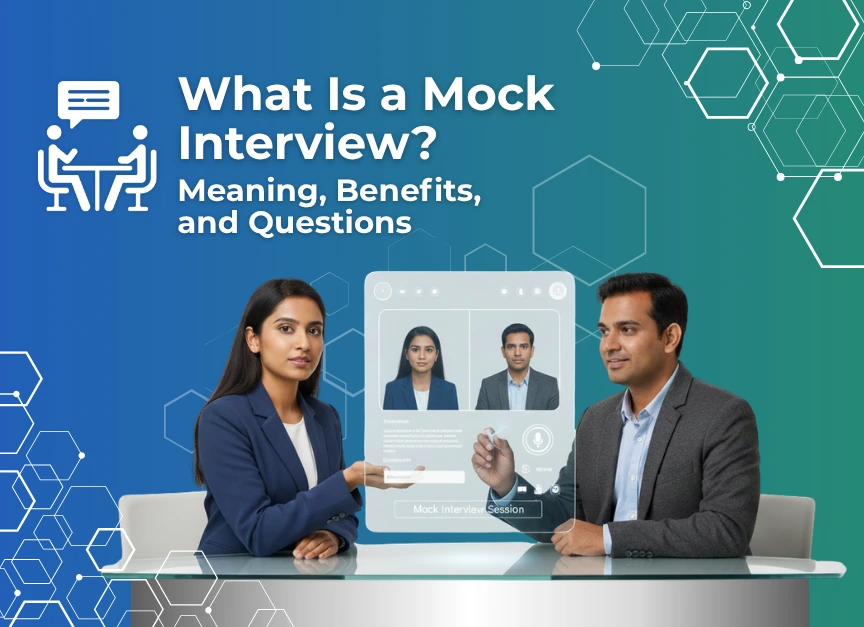
To clarify, a mock interview is a structured practice session designed to simulate a real job interview. Its purpose is to prepare candidates for actual hiring interviews by recreating the interview environment as closely as possible. During a mock interview, candidates respond to realistic interview questions while being observed and evaluated in terms of communication, confidence, clarity, and overall presentation.
In simple terms, the mock interview definition can be described as a safe rehearsal of a job interview where mistakes are allowed, and learning is prioritised. Since there is no risk of rejection or selection, candidates can focus entirely on improving their performance rather than worrying about outcomes. To illustrate, a student preparing for campus placements struggled to answer the question “Tell me about yourself” and often spoke in long, confusing sentences. During a mock interview conducted by the college placement cell, the student received feedback and practised a clear one-minute introduction. In the real interview, the student delivered the answer confidently and was selected. This shows how mock interviews directly improve real interview performance.
A mock interview typically includes the following elements:
-
The candidate answers commonly asked behavioural, situational, and technical mock interview questions.
-
The interviewer behaves like a real recruiter by listening carefully, asking follow-up questions, and evaluating responses.
-
The session follows a formal structure with introductions, time limits, and professional interaction.
What Are the Different Types of Mock Interview?
Preparing for interviews doesn’t have to feel boring or stressful—especially when you know the right ways to practise. Different types of mock interviews are designed to build specific skills, so you don’t just prepare… you prepare smartly. Each type gives you a new perspective and helps you improve step by step.
1) Telephone Mock Interview
A Telephone Mock Interview happens on a normal call. The interviewer asks questions, and you answer without seeing them. You only rely on your voice. For example, if you speak too fast or unclear, it becomes obvious—so you learn to sound calm and confident.
2) In-Person Mock Interview
An In-Person Mock Interview with a Colleague is like sitting face-to-face with someone you know. They ask questions like a real interviewer while observing your body language. For example, they may notice you avoid eye contact or sit nervously and guide you to improve.
3) Video Mock Interview
A Video Mock Interview happens on Zoom or Google Meet. You sit in front of a camera, just like a real online interview. For example, you might realise your background looks messy or your face isn’t clearly visible—small fixes that improve your impression.
4) Group Mock Interview
A Group Mock Interview includes multiple candidates together. You are given a topic, and everyone shares ideas. Here, you learn when to speak and how to stand out without interrupting others.
5) Technical Mock Interview
A Technical Mock Interview focuses on your skills. You might be asked to solve a problem or explain a concept step by step, just like in real technical rounds.
6) Face-to-Face (1-on-1) Mock Interview
A Face-to-Face (1-on-1) Mock Interview feels like a real interview from start to end—formal questions, proper structure, and detailed feedback.
Why Mock Interviews are Important?
The transition from being a “qualified candidate on paper” to becoming a “hired professional” happens during the interview. Mock interviews prepare candidates for this crucial stage in several practical and meaningful ways.
1) Reducing Anxiety and Building Confidence
Interview anxiety is one of the most common reasons for poor performance. Nervousness often leads to blank answers, rushed speech, shaky voice, weak body language, or confusion—even when candidates know the correct answers. This anxiety usually arises from uncertainty and a lack of familiarity with the interview process.
Mock interviews help reduce this anxiety by making the experience familiar. When candidates repeatedly practise answering difficult mock interview questions in a mock setting, the real interview no longer feels unfamiliar or intimidating. Confidence grows naturally with repetition, and candidates learn to speak calmly and clearly under pressure.
2) Identifying Non-Verbal Communication Issues
Many candidates focus only on what they say and ignore how they say it. However, interviewers pay close attention to non-verbal communication, including posture, eye contact, facial expressions, tone of voice, and gestures.
Mock interviews help identify unnoticed habits such as:
-
Poor eye contact, which signals insecurity
-
Slouching or poor posture, which looks unprofessional
-
Fidgeting or playing with hands, showing nervousness
-
Nervous facial expressions
-
Overuse of filler words like “um,” “uh,” or “basically.”
Once these issues are identified, candidates can consciously work on correcting them before the real interview.
3) Refining the “Tell Me About Yourself” Answer
Almost every interview begins with “Tell me about yourself,” yet many candidates answer this poorly. Some speak too long, others include irrelevant personal details, while some fail to connect their background to the job role.
Mock interviews help candidates develop a short, clear, and professional introduction that explains:
-
Their background
-
Relevant skills or experience
-
What they can offer in the role
-
Their career direction
With repeated practice during mock interviews, this answer becomes structured and confident.
A Few Common Mock Interview Questions To Practice
Practising the right interview questions is essential, as real interviews often follow similar patterns. Most real interviewers ask similar mock interview questions to evaluate behaviour, decision-making, and communication skills.
1) Behavioural Questions (Using the STAR Method)
Behavioural questions focus on past experiences to predict future performance. Examples include:
-
“Tell me about a time you resolved a conflict at work.”
-
“Describe a stressful situation and how you handled it.”
-
“Tell me about a failure and what you learned from it.”
Mock interviews help candidates practise using the STAR method (Situation, Task, Action, Result), which ensures answers are clear, complete, and easy to follow.
2) Situational Questions
Situational questions test decision-making and problem-solving ability. Examples include:
-
“How would you handle an unhappy client?”
-
“What would you do if you discovered a serious mistake after submitting work?”
Mock interviews teach candidates to explain their thinking step by step rather than giving short or panicked answers.
3) Personal and Career-Oriented Questions
These questions explore motivation and long-term goals, such as:
-
“Why are you leaving your current job?”
-
“Where do you see yourself in five years?”
-
“What is your greatest weakness?”
Mock interviews help candidates avoid negative or unclear responses and instead give professional, thoughtful answers aligned with the role.
Let’s take a trip to some common interview questions on: Top 14 Common Interview Questions & Answers for Freshers
Advantages of Conducting a Mock Interview
To rank well and truly help readers, your content should clearly explain real, practical benefits—with simple examples. Here’s a strong, SEO-friendly breakdown:
1) Builds Confidence in Real Interviews: Mock interviews reduce fear by giving you repeated practice in a safe environment. As a result, a candidate who used to panic during interviews becomes calm and confident after practising common questions multiple times.
2) Improves Answer Structure and Clarity: You learn how to give clear, to-the-point answers instead of long or confusing ones. For example, instead of giving a 3-minute unclear answer, you learn to deliver a strong 1-minute response.
3) Identifies Weak Areas Early: Mock interviews highlight mistakes you may not notice yourself. To illustrate, you may realise you speak too fast or use too many filler words like “um,” which you can fix before the real interview.
4) Enhances Body Language and Communication: Interviewers judge non-verbal cues as well. Mock interviews help improve posture, eye contact, and tone. With this, a candidate who avoids eye contact learns to maintain it, creating a stronger impression.
5) Prepares You for Real Interview Questions: Practising mock interview questions makes real interviews feel familiar and easier. In this way, Questions like “Why should we hire you?” no longer feel difficult because you’ve already practised them.
6) Improves Time Management: You learn to answer within time limits without over-explaining. Instead of speaking too long, you learn to give concise and impactful answers.
7) Provides a Real Interview Experience Without Risk: It simulates real pressure but without the fear of rejection. For example, you experience a full interview flow and feel prepared instead of overwhelmed.
Conclusion
Understanding the mock interview meaning is essential for every job seeker who wants to perform confidently during real interviews. For candidates asking “what a mock interview is” and whether it is useful, mock interviews provide safe practice, clear feedback, and real improvement. By regularly practising common interview questions, job seekers reduce anxiety, improve communication skills, and significantly increase their chances of interview success.
FAQs
1. What is mock interview meaning?
A mock interview is a structured practice session that simulates a real job interview. It helps candidates improve confidence, communication, and answer quality before facing actual interviews.
2. How many mock interviews should I take?
Ideally, you should take at least 2–3 mock interviews. However, practising more can further improve confidence, clarity, and overall performance.
3. Are mock interview questions similar to real interviews?
Yes, most mock interview questions are designed based on commonly asked real interview questions, making your preparation more practical and relevant.
4. Can mock interviews really improve performance?
Absolutely. Mock interviews help reduce anxiety, improve communication skills, and make you more comfortable with interview situations.
5. Are online mock interviews effective?
Yes, online mock interviews are highly effective, especially for virtual hiring. They help improve camera presence, speaking clarity, and confidence in online settings.