
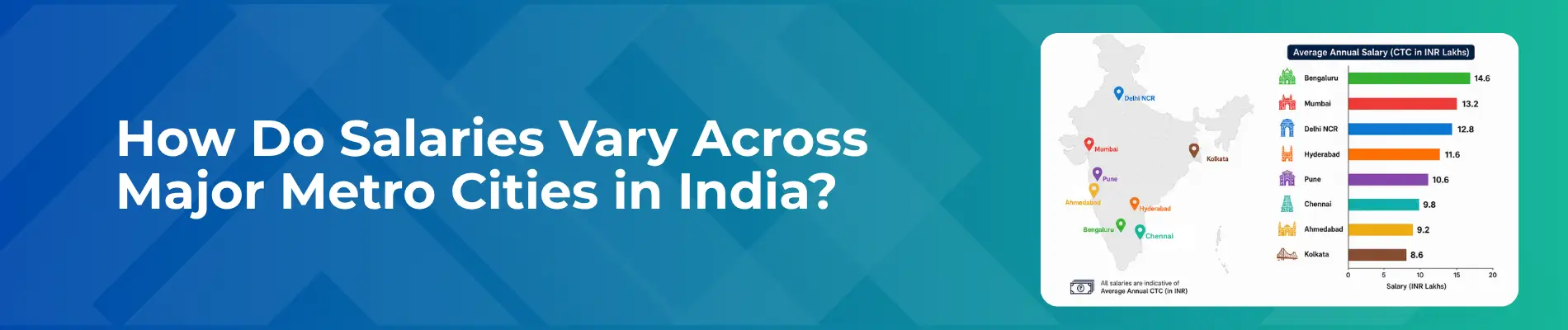
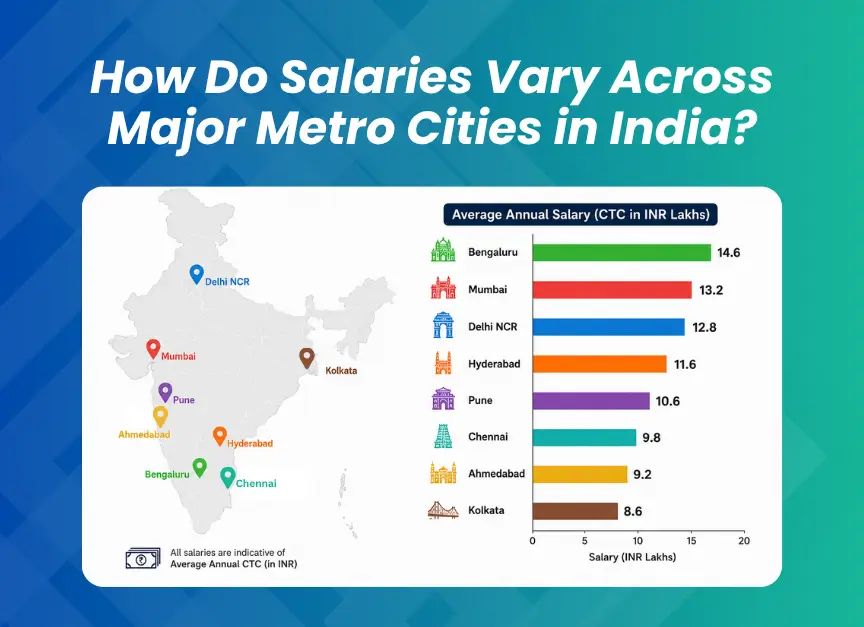
How Do Salaries Vary Across Major Metro Cities in India?
Written By JobsBob Editor Team
Updated 20 June 2026
In today’s job market, where you live in India can significantly impact not just your salary, but also your savings and lifestyle. Metro cities like Bengaluru, Mumbai, Delhi NCR, Hyderabad, and Pune acts as major employment hubs, each offering different salary structures based on dominant industries and cost of living.
Salaries in India’s metro cities are not uniform—they are shaped by the strength of local industries, demand for skilled talent, and overall economic development. For example, Bengaluru leads in technology roles, Mumbai dominates finance and media, while Delhi NCR offers diverse opportunities across sectors. As a result, compensation levels vary widely from one city to another.
A few key patterns stand out:
-
Industry-driven pay: Cities with strong sectors like IT, finance, and consulting typically offer higher salaries.
-
Established economic hubs: Bengaluru, Mumbai, and Delhi NCR continue to lead due to mature job markets and global company presence.
-
Rising competition: Hyderabad and Pune are emerging as strong alternatives with growing opportunities and competitive pay.
-
Intra-city variation: Salaries differ based on experience, skills, company size, and role type.
These factors show that salary differences across metro cities are closely tied to industry specialization and economic maturity. In this blog, we’ll break down how salaries vary across major metro cities in India and what those differences mean for career growth and lifestyle choices.
Salary and Career Comparison Across Major Metro Cities
Beyond just numbers, let’s have a look closer look at how salaries, opportunities, and growth vary across a list of metro cities in India:
1. Bengaluru: The Tech Powerhouse
Bengaluru stands out as one of the highest-paying metro cities in India. Its dominance in key industries such as IT and software services, startups and SaaS, artificial intelligence (AI), and data science drives strong demand for skilled professionals. This thriving ecosystem makes the city a hub for innovation, offering excellent career growth and competitive compensation.
|
Dominant Industries |
Average Salary (LPA) |
Salary Drivers |
Cost of Living |
Overall Salary Potential |
|---|---|---|---|---|
|
IT, SaaS, AI, Startups |
₹7–11 LPA |
High demand, global companies, startup ecosystem |
Very High |
★★★★★ |
Advantages
-
Access to some of the highest-paying technology roles in India.
-
Strong exposure to global projects and innovative startups.
-
Fast career growth opportunities in emerging tech domains.
Challenges
-
High cost of living, especially housing and rent.
-
Traffic congestion and infrastructure pressure due to rapid urbanization.
-
Competitive job market with high skill expectations.
2. Mumbai: The Financial Capital
Mumbai ranks among India’s top-paying metro cities. Known as the country’s financial and commercial capital, it thrives on industries such as finance, banking, media, and corporate services. The city attracts ambitious professionals seeking rapid career progression, strong professional networks, and exposure to high-value business environments.
|
Dominant Industries |
Average Salary (LPA) |
Salary Drivers |
Cost of Living |
Overall Salary Potential |
|---|---|---|---|---|
|
Mumbai Finance, Media, Banking |
₹6–10 LPA |
Financial hub, corporate HQs, media industry |
Very High |
★★★★★ |
Advantages
-
Strong career growth opportunities with access to leading financial and corporate firms
-
Exposure to top-tier corporate, banking, and global business environments
-
Excellent networking ecosystem with industry leaders.
Challenges
-
Extremely high cost of living, especially housing and rentals
-
Expensive daily lifestyle and transportation costs
-
High work pressure and a competitive corporate environment
3. Delhi NCR: The Diverse Opportunity Hub
Delhi NCR offers a competitive salary range, supported by its diverse economic landscape. The region hosts a mix of industries, including consulting, IT services, e-commerce, and government sectors. Its broad employment base makes it a preferred choice for professionals seeking varied career paths and flexibility across domains.
Dominant Industries
Average Salary (LPA)
Salary Drivers
Cost of Living
Overall Salary Potential
Delhi NCR
IT, Consulting, Govt, Corporate
₹5–9 LPA
Diverse industries, MNC presence, consulting firms
High
★★★★Advantages
-
Diverse employment opportunities across industries such as IT, consulting, e-commerce, government, and corporate services
-
Greater flexibility to switch industries, roles, and career paths
-
Strong presence of multinational companies and rapidly growing business hubs in Gurgaon and Noida
Challenges
-
Air pollution and environmental concerns can affect the quality of life
-
Salary levels can vary significantly based on industry, role, and location within the NCR region
-
Traffic congestion and long commute times in certain areas can impact work-life balance
4. Hyderabad: The Rising Tech Alternative
Hyderabad has emerged as a fast-growing metro city. The city is gaining recognition for its expanding presence in technology, pharmaceuticals, and startup ecosystems. With increasing investments and infrastructure development, it is becoming a preferred destination for professionals seeking stable growth and affordability.
|
Dominant Industries |
Average Salary (LPA) |
Salary Drivers |
Cost of Living |
Overall Salary Potential |
|---|---|---|---|---|
|
Hyderabad IT, Pharma, Tech Services |
₹5–8 LPA |
Growing IT hubs, lower costs, global firms |
Moderate |
★★★★ |
Advantages
-
More affordable cost of living compared to Bengaluru, Mumbai, and Delhi NCR
-
Expanding job opportunities across technology, pharmaceuticals, biotech, and startup sectors
-
Better work-life balance with improved infrastructure.
Challenges
-
Salary growth is still catching up with the compensation levels offered in top metro cities
-
Limited availability of premium leadership and highly specialized, high-paying roles
-
Smaller corporate ecosystem compared to established hubs like Bengaluru and Mumbai.
5. Pune: The Balanced Lifestyle Choice
Pune is widely recognized for its balanced work environment. The city has a strong presence in IT, manufacturing, and education, making it a stable employment hub. It is especially popular among young professionals who prioritize a comfortable lifestyle alongside steady career progression.
|
Dominant Industries |
Average Salary (LPA) |
Salary Drivers |
Cost of Living |
Overall Salary Potential |
|---|---|---|---|---|
|
Pune IT, Engineering, Automotive |
₹4–7 LPA |
Manufacturing + IT growth, startup expansion |
Moderate |
★★★ |
Advantages
-
Lower cost of living while maintaining a comfortable lifestyle.
-
Stable job market supported by IT, manufacturing, education, and research sectors
-
Less competitive and less stressful work environment compared to larger metro cities
Challenges
-
Limited availability of top-tier salary packages and executive-level opportunities
-
Slower career progression compared to major hubs like Bengaluru and Mumbai
-
Fewer multinational headquarters and large-scale corporate opportunities.
Salary vs Cost of Living: The Real Comparison
While salary figures across the list of metro cities in India give a basic idea of earning potential, they don’t always reflect financial comfort. The true impact of a salary depends on how it aligns with the cost of living in each city. Expenses such as rent, food, transportation, and lifestyle choices can significantly affect how much you save at the end of the month.
Cost of Living Comparison Across Metro Cities in India
|
City |
Avg. Salary (LPA) |
Avg. Rent (1BHK/month) |
Food & Utilities |
Transport |
Overall Cost |
|---|---|---|---|---|---|
|
Mumbai |
₹6–10 LPA |
₹25k–60k |
High |
High |
Very High |
|
Delhi NCR |
₹6–9 LPA |
₹12k–25k |
Moderate |
Moderate |
Moderate |
|
Hyderabad |
₹5.5–8 LPA |
₹10k–20k |
Low |
Low |
Low–Moderate |
|
Pune |
₹10k–22k |
₹10k–22k |
Moderate |
Low |
Moderate |
Which City is Best for You?
Choosing the right city depends on your career goals, lifestyle preferences, and financial priorities. Each metro offers unique advantages based on your professional needs.
-
For IT professionals: Bengaluru and Hyderabad offer the best IT opportunities due to strong tech ecosystems.
-
For finance and corporate careers: Mumbai provides unmatched exposure and growth potential.
-
For diverse career options: Delhi NCR is ideal for exploring multiple industries.
-
For better savings and lifestyle balance: Pune and Hyderabad are more suitable due to lower living costs.
Ultimately, the “best” city is not the one with the highest salary, but the one that aligns with your long-term goals and lifestyle.
Conclusion
Each city offers a unique combination of opportunities, growth potential, and lifestyle experience. While some cities accelerate careers, others support better financial balance and comfort. The key is to choose a location that aligns with your priorities, whether it’s rapid professional growth, stability, or quality of life, ensuring a more sustainable and fulfilling long-term career journey.