What to Write in a Cover Letter for a Job (2026 Guide)
Written By JobsBob Editor Team
Updated 21 July 2026
For placements, everyone has similar degrees—so your cover letter becomes your voice and helps you stand out. Your cover letter is not just a formality; it’s your chance to tell your story in a simple, real way. When thinking about what to write in a cover letter for a job. Think of it like introducing yourself to someone new: who you are, what you’re good at, and why you want to join them.
Start with a clear intro, then share your skills, small wins, or projects that prove what you can do. Keep it short, honest, and human—because a short cover letter for job application works best when it feels real, not copied. Even as a fresher, your effort, learning attitude, and curiosity matter a lot. Show why you like the company and how you can help them grow.
Don’t overcomplicate it—simple words win. Ask yourself one thing: “Would I hire me after reading this?” If yes, you’re on the right track.
Start writing today and make your cover letter impossible to ignore!
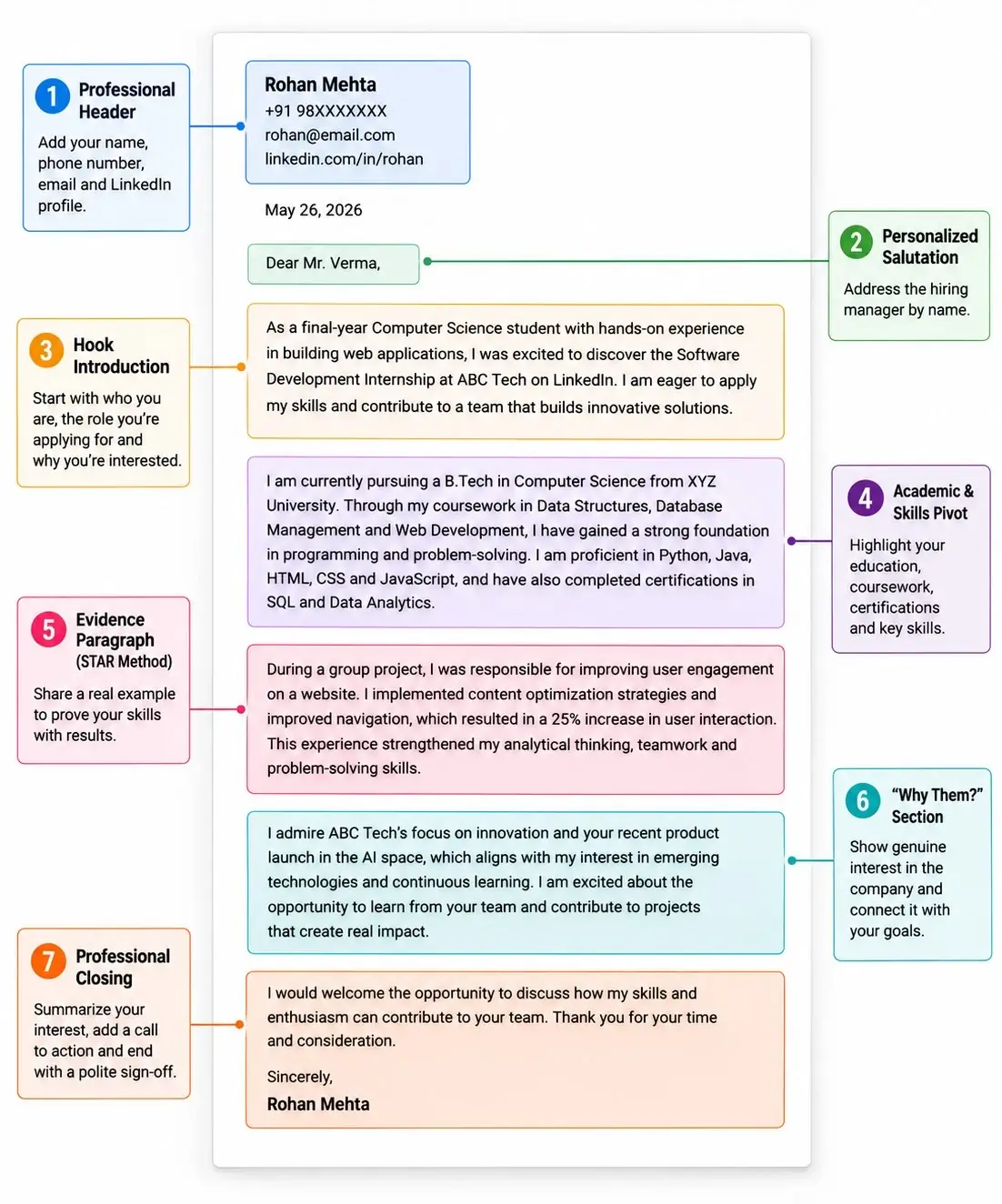
7 Essential Parts of a Professional Cover Letter
Writing a cover letter is not about filling a page—it’s about following a smart structure that makes recruiters stop, read, and remember you. Let’s break it down in a simple and practical way.
Part 1: The Professional Header
The header is the first thing a recruiter notices, so it must look clean, professional, and easy to read. Always include your full name, phone number, professional email address, and LinkedIn profile. Avoid adding unnecessary details like a full home address unless specifically required. Keep everything left-aligned because this is a more ATS-friendly format and visually simple. If you are applying for a technical or creative role, you can also include links to your portfolio, GitHub, or personal website. This shows that you are updated and serious about your career.
Example:
-
Rohan Mehta
-
+91 98XXXXXXX
-
rohan@email.com
-
linkedin.com/in/rohan
A well-structured header creates a strong first impression and signals professionalism even before the recruiter reads your content.
Part 2: The Personalized Salutation
The way you start your cover letter matters more than you think. A generic greeting like “To Whom It May Concern” feels outdated and impersonal. Instead, try to find the name of the hiring manager by checking LinkedIn, the company website, or the job posting. Look for roles like HR Manager, Talent Acquisition Specialist, or Department Head. Addressing someone by their name shows effort and attention to detail.
Example:
-
Dear Mr. Verma
-
Dear Ananya Kapoor
If you cannot find a name, use “Dear Hiring Manager” as a safe option. Avoid overly casual greetings like “Hi” or “Hello Team.” A personalized salutation makes your application feel human and increases your chances of getting noticed.
Part 3: The “Hook” Introduction
Your introduction is your chance to grab attention quickly. Recruiters often scan applications in seconds, so your first few lines should clearly state who you are, which role you are applying for, and why you are interested. Avoid boring and overused lines like “I am writing to apply for…” Instead, start with something engaging and specific about your background or interest.
Example:
“As a final-year Computer Science student with hands-on experience in building web applications, I was excited to discover the Software Development Internship at ABC Tech on LinkedIn.”
This type of opening instantly shows relevance and enthusiasm. A strong introduction sets the tone and encourages the recruiter to keep reading your cover letter.
Part 4: The Academic & Skills Pivot
If you are a fresher or applying for a placement, your academic work becomes your main strength. Use this section to highlight relevant subjects, coursework, certifications, and skills that match the job role. Mention tools, technologies, or methods you have used in your projects or assignments. Focus on practical knowledge rather than just theory.
Example:
“During my coursework in Data Analytics, I worked with Excel and Python to analyze datasets and generate insights, which improved my problem-solving and analytical skills.”
You can also mention teamwork, presentations, or research work. This section helps recruiters understand what you are capable of, even if you don’t have formal work experience yet.
Part 5: The Evidence Paragraph (STAR Method)
This is one of the most important parts of your cover letter because it proves your abilities with real examples. Instead of simply saying you are hardworking or skilled, use the STAR method to explain a situation where you demonstrated your abilities. Describe the situation, your task, the actions you took, and the results you achieved.
Example:
“During a group project, I was responsible for improving user engagement on a website. I implemented content optimization strategies and improved navigation, which resulted in a 25% increase in user interaction.”
Always try to include numbers or measurable outcomes to make your example stronger. If you’re writing a cover letter for job application for freshers, this part becomes your biggest strength. Even small wins—college work, internships, or volunteer tasks—can turn into powerful examples. Always try to add numbers or results, because they make your story believable.
Part 6: The “Why Them?” Section
This section shows whether you are genuinely interested in the company or just applying randomly. Instead of focusing on what you will gain, talk about what you admire about the company. Research their recent work, achievements, values, or projects, and mention something specific. Then connect it with your own interests or skills.
Example:
“I admire your company’s focus on innovation and your recent product launch in the AI space, which aligns with my interest in emerging technologies and continuous learning.”
In a cover letter for job application for freshers, this section helps you stand out even without experience. It proves you’ve done your homework and truly want this job—not just any job.
Part 7: The Professional Closing
Your closing paragraph should leave a strong and confident impression. Briefly summarize your interest in the role and mention how your skills can contribute to the company. End with a polite call to action and thank the recruiter for their time. Keep it professional and to the point.
Example:
“I would welcome the opportunity to discuss how my skills and enthusiasm can contribute to your team. Thank you for your time and consideration.”
Finish with a professional sign-off like “Sincerely” or “Best regards,” followed by your name. A strong closing reinforces your interest and encourages the recruiter to take the next step, such as scheduling an interview.
Document SEO: Format Your Cover Letter to Get Noticed
Just as a blog needs SEO to rank, your cover letter needs “Document SEO” to be seen, read, and selected. Even strong content can fail if the formatting looks messy or hard to scan. Recruiters don’t read—they scan. So your layout must guide their eyes smoothly.
-
Font Choice: Use modern, clean fonts like Inter, Roboto, or Calibri at 11pt. Avoid decorative or outdated fonts like Times New Roman unless required. Your font should feel easy, not heavy.
-
White Space: Use 1-inch margins and break content into short paragraphs (3–5 lines max). Big blocks of text feel overwhelming and are often skipped.
-
File Naming: Never save your file as “CoverLetter.pdf.” Instead, use:
FullName_Role_CoverLetter.pdf -
PDF vs Word: Always send a PDF unless asked otherwise. It keeps your formatting consistent across all devices.
Avoid These Common Cover Letter Errors
Even a strong cover letter can fail because of small but critical mistakes. Avoiding these errors can instantly improve your chances of selection.
-
Regurgitating the CV: Your cover letter is not a copy of your resume. It should explain your journey, decisions, and impact behind those bullet points. Add meaning, not repetition.
-
The “I” Trap: Starting every sentence with “I” makes your writing repetitive and weak. Instead of “I did this,” reframe it to sound more professional and impactful. Example:
“Through my academic project, I developed…” -
Typos and Errors: One spelling or grammar mistake can lead to rejection, especially for detail-oriented roles. Use tools like Grammarly, but always do a final manual check.
-
Being Too Humble: This is your chance to sell yourself. Don’t hide your achievements—highlight them with confidence and clarity.
Cover Letter Template for Job Placement
Don't wait for the perfect opportunity to start. Practice writing a cover letter for a job, customize it for every application, and let your story speak with confidence.
Conclusion
Whether you are a fresher applying for campus placements or an experienced professional exploring new opportunities, following a simple and clear structure, tailoring your content to each company, and avoiding common mistakes can significantly improve your chances of getting shortlisted. Always remember, recruiters appreciate authenticity and genuine interest in their organisation.